The Holy Quran is a compilation of the verbal revelations given to the Holy Prophet Muhammad (saw) over a period of twenty two years. The Holy Quran is the Holy Book or the Scriptures of the Muslims. It lays down for them the law and commandments, codes for their social and moral behaviour, and contains a comprehensive religious philosophy. The language of the Quran is Arabic.
Besides its proper name, the Quran is also known by the following names:al Kitab The Book;al Furqan The Discriminant: al Dhikr The Exposition; al Bayan The Explanation; al Burhan The Argument; al Haqq The Truth; al Tanzil The Revelation; al Hikmat The Wisdom; al Huda The Guide; al Hukm The Judgment; al Mau'izah The Admonition; al Rahmat The Mercy; al-Noor The Light; al-Rooh The Word
Surahs And Verses
The Holy Quran is divided into 114 Surahs or Chapters and each Chapter consists of individual Ayaat or verses. There are in total 6,348 verses in the Holy Quran. The Surahs are of varying lengths, some consisting of a few lines while others run for many pages. Surah al Baqarah (Ch.2 ) is the longest Chapter comprising 287 verses while Surah al Kauthar( Ch. 108) is the shortest with only four verses including the tasmia.
The text of the Holy Quran has remained unchanged over the past 1400 years. The millions of copies of the Quran circulating in the world today are all identical down to a single letter. And this is not strange since God says in the Holy Quran that He Himself will guard this book:
"Surely it is We Who have revealed the Exposition, and surely it is We Who are its guardians" (15:10)
Showing posts with label Khalifa. Show all posts
Showing posts with label Khalifa. Show all posts
Monday, March 28, 2011
The Holy Qur'an, Part 1


Saturday, June 12, 2010
7th Annual Peace Symposium: How to Establish Peace in the World
Keynote address delivered by His Holiness, Hadhrat Mirza Masroor Ahmad, Khalifatul Masih V, Head of the Worldwide Ahmadiyya Muslim community (may Allah strengthen his hand) at the Ahmadiyya Muslim community’s Peace Symposium held at the Baitul Futuh Mosque on 20th March 2010.
(I bear witness that there is none worthy of worship except Allah; He is One and has no partner. And I bear witness that Muhammad is His Servant and Messenger. After this, I seek refuge with Allah from Satan, the rejected. In the Name of Allah, the Gracious, the Merciful)
All the distinguished guests gathered here tonight, Assalamu ‘Alaikum Wa Rahmatullahi Wa Barakatuhu – peace and blessings of Allah be upon you all.
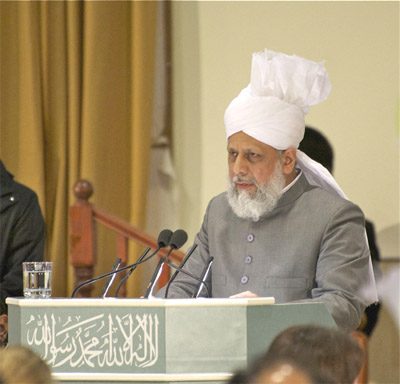
After another year, a lovely evening has once again come when our dear friends belonging to different faiths and countries, but who are mostly British, have gathered here because they have a connection with the members of our community.
Some are old acquaintances, of course, and others are new. The fact that people of different countries, religions and cultures have come together and spared us their valuable time proves that they are all noble and decent persons with a desire for achieving a high objective, an objective that is the burning desire of every sincere person in this day and age. And so today, we have gathered here to talk about and listen to that word that can bring about tranquillity and contentment within our heart, and that word is ‘peace’!
This is but one word, yet it guarantees the tranquillity of one’s heart; it is the guarantor of the tranquillity of our home; it assures the betterment and welfare of society; and it guarantees the prosperity of our nation. So, when this word confers so many benefits then why should we not find it attractive? Why should it not be the burning desire of the heart of every good person?
To achieve anything, you must work hard for it. You have to make sacrifices. The higher the objective, the higher is the sacrifice required.
It is necessary that a code of conduct be established in which a person has to sacrifice his or her emotions and respect the feelings and sentiments of others. It is necessary that a person should stand on his own two feet and safeguard himself from envying the wealth of others and it is necessary that one should help the poor and yet be happy to live within one’s means. In short, if you desire to establish peace at any level, then it is essential that high moral values are exhibited, and guidelines need to be established for this.
The Holy Prophet of Islam, peace and blessings of Allah be upon him, has taught us a golden principle, which is to choose for your brothers what you choose for yourself, because the lack of peace is caused by an anxiety of the heart.
If we look at the world today, the majority are victims of deprivation, cruelty and injustice. Many powers are cruel and unkind to their own people, whether the cruelty is in the name of religion or the State itself. And Western governments, directly or indirectly, are involved in this oppression.
And these anxieties are borne whenever deprivation is felt; when one feels oppressed; when one feels inferior and feels that there is no hope for justice; when the gap between the rich and poor widens; when one feels that there is a lack of equal opportunities for progress; when there are interferences in a person’s faith by the powerful; and, when a country tries to prove its supremacy over another, and in the name of aid a superior power tries to take hold of the resources of another country.
When this golden principle is forgotten – of choosing for your brother what you choose for yourself – then these and many other similar factors blow peace into pieces.
It is extremely difficult to live up to this golden principle. If we reflect upon these major factors that I have spoken about that are required to establish peace, then disregarding self-centred persons who only think of themselves, even those who truly long for peace do not follow this principle to the standard required. And that standard, of course, is that what you choose for your brother you choose for yourself.
There are many people who want to create an atmosphere of love, affection and brotherhood, yet how many people are actually willing to sacrifice their own wealth so that the situation should improve and restlessness should end? At an individual level there might be a few exceptions, here and there, where perhaps many people give a petty sum of charity, but it is an insignificant sacrifice and they are barely willing to forsake their emotions. When a large chunk of society and many countries become the victims of deprivation and cruelty, and become restless due to injustice, then hatred grows and such small sacrifices are rendered useless.
If we look at the world today, the majority are victims of deprivation, cruelty and injustice. Many powers are cruel and unkind to their own people, whether the cruelty is in the name of religion or the State itself. And Western governments, directly or indirectly, are involved in this oppression.
For example, will the hunger and famine in Ethiopia ever allow peace to be established in the country? On TV we see that very limited aid is being given to that country, but in this famine-ridden and economically shattered nation, such aid is hardly being used to feed the bellies of the starving people.
A larger amount is spent helping the rebels or the armies of the governments to purchase arms so that the so-called leaders can retain control. Ethiopia is incapable of manufacturing weapons. So the weapons must be reaching them from powerful nations, or from particular factions in wealthy countries who have cast their net like the Mafia.
Why have the powerful countries not tried to find a solution to this deprivation, cruelty and injustice in the world? Merely issuing a statement or summoning a meeting of a committee of the United Nations and expressing disapproval is not enough.
Similarly, it is wholly inadequate for the powerful countries to express sympathy with the Palestinians on TV. Why can an effort not be made to establish peace in the same way as in Iraq and Afghanistan? I am not saying that what has occurred in Iraq and Afghanistan is right or wrong, but am merely pointing out that the more powerful countries took action according to their own perception to establish peace. A Public Inquiry about the Iraq War is taking place at present in the UK and many of the government officials involved are continuing to maintain that the war was justified, in spite of the fact that the vast majority of the UK public and its politicians consider the action to have been unjustified.
Now the people of Iraq and Afghanistan are reacting in their own way to these acts in response. It was a presumption that if action was not taken against those in power, then there would be a grave threat to world peace, and so action was taken to preserve the rights of the people; but, on the other hand, was similar effort not required to protect the Palestinians from external attacks? Even if we suppose that the Palestinians initiated the war, such a disproportionate punishment could never be justified, whereby innocent children, women, elders and the unarmed are bombarded indiscriminately; an entire city is reduced to rubble. The Western media raised a great outcry, no doubt, and although the super-powers issued statements, no concrete steps were taken to stop Israel from continuing this cruelty.
Can those innocent children who saw their homes being destroyed; who saw their brothers and sisters being killed without any reason; who saw their helpless parents targeted whilst pleading for their lives; can those innocent children ever erase those horrific scenes from their memories? Their inner frustration will make them anxious, and when this anxiety is manifested, it will result in further disorder and that will lead to a reaction to check it. And as is evident from the history of Palestine, such a reaction will, of course, lead to further cruelty on them.
In today’s world, when an event occurs in one place, it is broadcast instantaneously throughout the world. As a consequence of witnessing images of such cruelty, Muslims will, no doubt, develop hatred, and such hatred will continue to increase. Malice and grudges in people’s hearts will multiply. There is already talk of this cruelty being repeated. Let us see what steps these major powers take to prevent this happening.
The Holy Prophet, peace and blessings of Allah be upon him, has taught us that to develop peace and to remove hatred from your heart a person must help both the oppressor and the oppressed. Hearing this, his Companions said that they could understand the principle of helping the oppressed, but how could they help the oppressor? The Holy Prophet, peace and blessings of Allah be upon him replied that you can help the oppressor by stopping him from acting cruelly so that he can be saved from the Wrath of God.
It is necessary, therefore, to take practical steps to stop cruelty, regardless of whether it is the mighty or the weak that are inflicting the cruelty. Peace will not be established merely by adopting UN Resolutions; practical steps must be taken. It is necessary to establish trust and build confidence and for this absolute equality must prevail. Differences between the rich and developed and poor and developing countries must be eliminated. All forms of veto powers should be removed and the finer points of justice need to be identified. We need to be loyal to our covenants, our obligations and our status, and this loyalty can only occur when it is followed to the letter and spirit of the law; double standards should be eliminated. Indeed, the media has also been calling for this.
The Holy Qur’an has taught us how to fulfil the requirements of justice; it says that even if you have to testify against yourself or your relative then you must do so. How many matters are there that are presented in such an institution that was constituted after the Second World War so that the world could be saved from the horrors of war in future, where the major powers accept criticism against themselves and where they admit their own mistakes?
The decision of not admitting one’s own error was taken at that time when the United Nations was formed and a provision for veto power was granted to the five major powers. The fundamental requirement for justice of even giving evidence against oneself was denied. How can this institute establish justice? The strange thing, as I mentioned before, is that they were not loyal to their own principles.
Loyalty is borne from feelings of love and affection. At a personal level the feeling of love strengthens the feelings of loyalty. When a citizen loves his country then he exhibits allegiance and makes sacrifices for the sake of the nation.
If sentiments of love do not exist, then the spirit of sacrifice cannot be formed. Unless a person loves another he can never have good feelings in his heart towards him and he cannot faithfully fulfil the rights due to that person.
In an age where the electronic media has drawn us closer together, into what is called a global village, its benefit will only be felt when mutual goodness prevails. If, instead of good feelings, hatred emerges, if restlessness usurps heartfelt peace, then you must accept that this is not progress, but is something that will take you towards horrific destruction.
Here, I wish to make something very clear, and that is the relationship of mutual love, affection and loyalty between one person and another cannot be established until a relationship of love, affection and loyalty with the Lord Who created us is developed. Distress and anxiety exist nowadays in a large part of the world’s population because the world has forgotten its Creator. People have forgotten the fundamental teachings of their faith. In fact, a great number of people even reject the existence of God.
The Founder of the Ahmadiyya Muslim community has also taught us that the majority of Muslims and non-Muslims have forgotten their fundamental teachings and have gone far away from God. This growing distance from God and religion is increasing the restlessness in the hearts of people. And he said that he had come, therefore, to remove such distance so that the rights of God may be discharged and the rights of God’s creation may also be discharged with feelings of love and sympathy. When these teachings are acted upon then we will observe real peace; otherwise, agitation will once again bring about utter destruction in the world.
With reference to peace, I would like to also say that turmoil and restlessness has spread all over the world and every possible way to reduce it should be adopted. Instead of unnecessarily interfering in the affairs of others and erecting walls of hatred, we should look to knock them down. The governments should not interfere where rights are not being violated. No laws should be proscribed regarding those matters that do not endanger the peace of the nation. Of course, where there is a threat to the peace of the nation; where there is a likelihood of harming the prosperity and progress of the nation; where the rights of citizens are unduly curtailed and where a person is made a symbol of hate due to his religion, there the Governments should interfere and legislate.
Allegiance to one’s country should be infused amongst the entire society, and most importantly, the love of God should be instilled in the hearts of the people.
As I said before, and as you are all aware, the world has come together and the measures of distances have changed, and in every country people of different religions live side by side. Therefore, it is necessary and it is the need of the time that within our cosmopolitan societies, the bond of love and affection should be strengthened. Respect and honor for one another should be inculcated. Allegiance to one’s country should be infused amongst the entire society, and most importantly, the love of God should be instilled in the hearts of the people.
If these things are fostered then they will guarantee harmony within each country, and individual restlessness will be replaced by peace.
Over the past few years the hijab, or veil, has been made an issue in Europe. In France, in particular, an uproar has been created, and now they are seriously considering legislation that would partially ban the hijab. Following on from France, politicians in other European countries, and for their own political motives, are issuing statements supporting a ban and this is becoming a means of injuring the sentiments of Muslims.
Whenever I have reflected on this matter, I have never been able to understand what the problem with the veil is that it has become such a threat to governments. Is it such a heinous crime to wear a coat and cover one’s head and chin with a piece of cloth that an entire Parliament should sit to pass a law against it? If it is prohibited for a woman to wear a cloth on her head, then why are men allowed to wear caps and berets on their heads? This means that tomorrow a ban could also be proposed against such caps.
I saw a cartoon recently in a newspaper in which a lady wearing a veil was standing next to a young man wearing a beret. The young man was saying to the woman, ‘no burqah’, and the woman was saying to the man, ‘no beret’.
These issues thus have become a source of sarcasm; however, there are some sober-minded people in whose hands are the reins of the Executive and Legislature who should not interfere with such matters. Should legislation be passed against Christian and Jewish ladies who also adopt religious attire? If bans are imposed against the Muslims, then Muslim countries may impose restrictions on some forms of Western dress in response. This issue has the potential to snowball and it will affect the peace of the world.
By all means, if there is any covering that hides the identity of a person and it is necessary to remove it to identify a person, then the governments or the authorities have the right to do so. But what a travesty, that a woman may be deprived from travelling simply because she is wearing the hijab; or a human life may be deprived of care in a hospital and left in the jaws of death because she was wearing a veil.
Then, for example, an intelligent girl – who ranks at the top of her class, who is not just a Muslim, but an asset to the country in which she lives, is loyal to her country in every possible way, so much so that the love of her country is ingrained within her and she is willing to sacrifice all her skills and abilities for the sake of the progress of her country – and if this girl is prevented from carrying on her education only because she chose to observe hijab, not out of any compulsion, but due to her own free will; does this not render her bereft of her rights as a citizen? Will not this legislation that deprives her of education be the means of wasting a national talent?
This law has not yet been passed in Germany, but due to the bye-laws available to the administration of some schools, an Ahmadi Muslim girl whom I know, who is among the top-ranked students, is being deprived of her education. And there are many examples like this.
This national talent and the future of the country is being denied just because a Muslim girl wants to serve her country and at the same time wants to practise her religion of her own volition and happiness. A girl is being deprived of this right merely because she has a metre worth of cloth on her head.
If this is a crime, then during the winter all European ladies will have to be deprived of their rights when they wrap their heads with scarves. Certainly, it is food for thought that whether it is such a crime to wear this one metre cloth, and whether wearing it renders a woman worthy of being deprived of her basic human rights.
Is this a definition of modern democratic governments that claim to safeguard the rights of its people? Is this the way to bring together people of different nations? Is this the way to foster love and affection amongst people? Most certainly, every just-minded person will oppose this because these things will make the walls of hatred ever higher and destroy the peace of the world.
Currently, the minarets of mosques have also become a major issue, in particular in Switzerland. I said recently at the 50th anniversary of one of our mosques in Germany, that if we suppose for one second that conspiracies are being hatched in mosques, then will bringing down the minarets stop such conspiracies?
Firstly, not every mosque can have such an objection raised against it. I said in Germany with certainty, and I say it here as well, that not a single allegation can be proved against Ahmadi mosques in any part of the world, that they are spreading the message of hatred or rebellion. If you really want to make such an allegation, and if you really want to make the allegation of destroying the peace, then wherever the conspiracy can be found, remove it from the map. Indeed, if you become aware of any conspiracies being hatched in any mosque or other place of worship, then it is the responsibility of the government to take immediate action. However, to make it a general rule that Muslims always hatch conspiracies in places of worship will sow the seeds of hatred.
Politicians in some countries make such statements as a means of cheap publicity. In Switzerland, it is only our mosque, the Ahmadiyya Mosque, that has a high minaret, and so in newspapers its picture is printed and it is referred to as ‘a symbol of peace and security’. Certainly, not all politicians are alike; there are some politicians who make it clear to even their party leaders that they are not in favour of such religious compulsion.
These days the world is passing through a financial crisis. It is said that the recession has ended, that we have passed through the worst and that now we are emerging from it to recovery.
But the public is still affected; jobs are still being lost; the purchasing power is still as affected as it was before. These are matters for governments and major steps must be taken, rather than making choices based on personal preferences.
Will a woman wearing or not wearing a veil affect the economy of the country or the world? Will the wearing or not wearing of a veil or having or not having a minaret affect the moral value of a country or will it lead to recognition of the Creator? Will the wearing or not wearing of a veil or having or not having a minaret improve or harm the peace of the world?
If it does, then I will be the first to accept it because Islam teaches that you should be willing to sacrifice something small for the greater good. But no! All these actions are strengthening the foundations of hatred.
For God’s sake, in order to remove this hatred within your own circles, please act with justice, act with equality, and respect the feelings of others so that the peace can be restored, as has been said by so many guest speakers, almost – not almost – but all the guest speakers.
Amongst us tonight, Lord Eric Avebury is present whom I gave the Ahmadiyya Peace Award to just now. I consider him to be extremely honourable because he has always been a stalwart and at the forefront of upholding human rights. May God enable him to continue this work further, because upholding human rights is the guarantor of world peace.
Likewise there are a lot of other distinguished guests like Tom Cox, who was also a guest speaker and an old friend of the Community; Justine Greening, our MP for Putney; Laura Moffatt, MP for Crawley; Stephen Hammond, MP for Wimbledon and Siobhain McDonagh, MP for Mitcham and Morden. May they continue to work for the cause of developing peace in society as they have already spoken about it.
It is my prayer that mankind understands the value of humanity and fulfils the rights owed to each other.
Finally, I would like to once again thank all of you, who have come here with good sentiments and graced this occasion with your presence and shown respect for fellow human beings.
Thank you very much.
Thursday, December 10, 2009
Sunday, August 23, 2009
Ramadhan Mubarak 2009
Excellence of fasting during Ramadan
Summary of Friday Sermon delivered by the Head of the Ahmadiyya Muslim Community
September 14th, 2007
Huzur delivered his Friday Sermon from Bait ul Futuh, Morden, England and gave a discourse on the excellence of fasting during Ramadan.
Citing verse 184 of Surah Al Baqarah (2:184) Huzur said that with the grace of Allah we are once again enabled to experience the most excellent arrangement for spiritual development, that is, fasting for the few days of Ramadan.
Each Ahmadi should make their best endeavours to develop in taqwa (righteousness), to seek Divine nearness, attain acceptance to one’s prayer, and develop in religious, moral and spiritual ways.
Remarking on the significance of the commandment to fast Huzur said it was also made obligatory on the followers of the earlier prophets of God for the purification of soul and among them only those became the recipient of blessings who abided by the commandment without any protest, who put the teaching in practice and excelled in taqwa. However, when they rejected the teachings, they lost their worldly glory as well as their standards of spirituality plummeted. Huzur said indeed when Allah enjoins the followers of prophets of God to adopt taqwa, He declares that it would lead them to the blessings of this world and the Hereafter, as it is stated in verse 47 of Surah Al Rahman (55:47). Huzur said it is vital for each Ahmadi to recognise the lofty station of God in order to develop in taqwa and to be the recipient of His blessings and this, he added, will come to pass when His commandments are followed with sincerity of purpose. One of these commandments is to fast.
We are fortunate that we are the adherents of the perfect Book, are the adherents of the Shariah which is promised to continue till the end, are the adherents of the last law-bearing Prophet (peace and blessings of Allah be on him) who was granted excellence over all the other prophets by being given the title of Khatam un Nabiyyeen (Seal of all the prophets). He brought us the message of Qur’an to enable us to stay firm on taqwa, a message that is still fresh today and shall always remain so. Huzur asked what do the commandments of this last law-bearing Book expect of us? Explaining, he said they expect us to endeavour for the attainment of the blessing that this Book mentions, to assume the undertaking for which God and His Prophet (peace and blessings of Allah be on him) have shown us the way.
Citing verse 70 of Surah Al Ankabut (29:70) Huzur said it is indeed God’s promise that He guides those to Him who come towards Him with absolute sincerity, He runs to those who at least walk towards Him. A great source to attain nearness to God is fasting. A Hadith relates that the Holy Prophet (peace and blessings of Allah be on him) said that Allah puts a distance of more than 70 years (Arabic idiom meaning a great deal) between the face of a person who fasts in the way of Allah seeking His blessings and fire. Huzur said indeed it is vital to fast in the quest of Allah’s grace and if the attainment of His pleasure is the sole objective, He not only saves one from the fire but also grants the paradise of His pleasure, in this world and the Hereafter.
The Promised Messiah (on whom be peace) said that one who makes a solemn endeavour to seek Allah never fails. He said that if we can feel compassion for a student who works hard for school exams how could God not have mercy and compassion to allow one who endeavours to seek him to come near Him? Certainly not.
Recounting a Hadith e Qudsi Huzur said Allah declares that each act of man is for himself, apart for fasting. Fasting is for Allah and Allah alone is its reward. Another Hadith reiterates this point that fasting is done for Allah and only Allah knows the real reward of a person who fasts.
Huzur explained that just as Allah’s attributes are countless so is the extent of His reward, however, He has set some limitations for the attainment of His reward. For example during fasting one is not required to merely starve oneself, rather one has to make an endeavour to shun all sorts of worldly and carnal desires, only then it may be deemed that fasting is for Allah alone. Similarly the avoidance from the ills is not to be temporary and brief, rather it has to be a permanent effort.
Indeed Allah knows what is in one’s heart, is aware of the intention behind each deed, has knowledge of what is apparent and what is hidden, if a person fasts with Allah’s attributes in mind, that fasting would be rewarded.
Huzur further said that when a person who is fasting responds to an abuse by saying that as they are fasting they will not respond in kind, it does not mean that after breaking the fast they are at liberty to retaliate, not at all. Huzur said fasting is a training process during which one is trained to eschew bad habits for good, that is the reason why a Hadith relates that when a person who fast sincerely meets his Maker he will be happy. It is not just thirty days’ effort that will give him happiness, rather he will be happy because he would have had an opportunity to make an endeavour to avoid bad habits and that person would thus greet each Ramadan of his life until he attains the station where he will be the recipient of Allah’s pleasure.
Elucidating a Hadith that terms fasting as a shield, Huzur said the important thing is to be able to utilise this ‘shield’ to protect oneself from the attacks of the Satan, the most dangerous of all enemies. A believer can be safe by means of this ‘shield’ through worship of God and by staying firm on His commandments.
Huzur said the teaching of the earlier prophets was temporary, it was for a temporary period of time. With the teaching diminished its freshness and taqwa. The teaching of the Holy Qur’an is eternal. Worldly desires crept into the fasting of other religions. We need to constantly make endeavours to keep the standards of our taqwa high. Each one of us should try to the best of his/her ability or capacity to attain the lofty standards. By calling us Khair e Ummah (best among the Ummah) Allah has shown us all the ways and we can only justifiably called Khair e Ummah when we can attain these standards. Huzur said the acts that are done to seek the pleasure of Allah are indeed what taqwa is all about.
Huzur prayed that may Allah enable us to make solemn endeavour to attain taqwa. The Promised Messiah (on whom be peace) said that fasting is about forsaking one kind of nourishment (food) to seek the other kind of nourishment which is for the soul. Allah opens up ways of guidance and spiritual discernment for those who seek Him with truthfulness of heart.
May Allah enable us that we fast while making the attainment of His pleasure our objective, may we attain spiritual discernment which becomes a lasting part of our lives and which enhances us in taqwa each moment.
Thursday, August 20, 2009
34th Annual Ahmadi Muslim Convention, Germany
Summary of Friday Sermon delivered by Hadhrat Mirza Masroor Ahmad at, the Head of the Ahmadiyya Muslim Community, August 14 th, 2009
NOTE: Alislam Team takes full responsibility for any errors or miscommunication in this Synopsis of the Friday Sermon
Today, Huzur delivered his Friday Sermon in Germany, opening the Jalsa Salana there with his discourse. Huzur said the objectives of holding the Jalsa Salana are to avail religious benefit, to increase one’s Divine cognisance merely with the grace of God, to enhance mutual love and brotherhood and to draw attention to Tabligh.
Huzur said during the spiritual atmosphere of Jalsa Salana special consideration is given to worship of God, in particular to congregational Tahajjud. It is hoped that with the grace and mercy of God, those who are perhaps not regular in offering Tahajjud would develop the habit. Worship of God facilitates Divine cognisance and this in turn draws one to pay the dues of mankind, to mutual love and to take the message of God to the world with intense fervour. All this comes to pass with God’s grace but in order to attain it one has to make the initial effort. Just as Hadith relates that God runs to those who walk towards Him, that is, the initial effort is made by man to seek God. In His infinite grace, God then augments our meagre efforts manifold. God states in the Holy Qur’an in Surah Al Ankabut; ‘And as for those who strive in Our path – We will surely guide them in Our ways…’ (29:70). Huzur said such is God’s love. He bestows general favours by virtue of His attribute of Rahman (Most Gracious) as well as confers distinctively to His special people. In coming to the Jalsa Salana one leaves behind worldly dealings, it is therefore that much pertinent to focus on attaining the objectives of Jalsa with sincerity. Otherwise, coming to the Jalsa would be a mere worldly exercise and the Promised Messiah (on whom be peace) expressed disgust for this.
The Promised Messiah (on whom be peace) said that God’s beneficence is granted to those who endeavour and strive in His way, who give alms and join among those who ‘strive in Our path’. He said just as an ailing person tries all kinds of remedies to get better, similar effort should be made for spiritual illness. Such an effort may not be merely verbal, rather it should be real striving.
Huzur said we should be grateful that having been enabled to accept the Promised Messiah (on whom be peace) we are guided on the right path to attain Divine cognisance. It is now up to us to derive full benefit from the effort, whether our own or that of our forefathers, that has resulted in us being granted this capacity. This would be real thankfulness. The aforementioned Quranic verse expresses God’s love for His servants just as the Hadith that relates God runs to those who walk to Him does. However, the words ‘those who strive’ in the Quranic verse make it clear that the initial effort has to be man’s. The Arabic term ‘Jahadu’ in the verse signifies endeavour made with all one’s capacity to attain piety and then to continue in this assiduousness. Huzur said it is not a trivial matter that one may say that he or she tried but was not guided. To attain the path of guidance it is conditional to be weary of wrongdoing just as perseverance is conditional. God has given man free will and has left Satan free. God also states that evil has apparent comfort and ease. However, when His servant makes an effort in His way, then God does not allow him to fall in the pit of fire. God reaches out like a loving mother and embraces His servant. If there is ever any deficiency in this relationship it is always due to the negligence of man. It is for man not to be like a misbehaving child, to be aware of his limitations and never consider himself to be independent of God.
With reference to those attending the Jalsa Salana and the striving in God’s way with prayers, Huzur said it is not sufficient to simply accept Ahmadiyyat. Fervent search for the path to nearness to God should be apparent in every action of an Ahmadi. Huzur said alms should be given with sincerity, Salat offered with its dues, Fasting observed with its dues, dues of relations and people maintained and trust honoured. Efforts to attain piety beget piety. Huzur said if a person has joined the system of Wasiyyat as introduced by the Promised Messiah (on whom be peace) to seek the pleasure of God, then such a person would ever be making endeavours to stay firm on taqwa (righteousness). In staying firm on taqwa, he or she will honour all the obligatory and optional dues of God, just as he or she will honour the obligatory and optional dues of people. This is the real Jihad, which, when undertaken with perseverance leads from one piety to another.
The Promised Messiah (on whom be peace) said that Istaghfar (seek forgiveness of God) is a means to attain God. He said the real significance of Istaghfar is to plead to God that one’s human failings are not made evident and God, with His power, covers them. That He saves us from natural weaknesses. It also signifies that may God cover any sin that one may have already committed.
Huzur said man should make great efforts against the assailment of Satan. His attempts to entice man are made by giving vast hopes. However, by giving us the source of Istaghfar God has promised us that whoever will make an endeavour and will persevere will be granted guidance. Fortunate are those who comprehend this and benefitting from the spiritual atmosphere of the Jalsa Salana, try and remove all their spiritual and moral weaknesses. Huzur said the words of the Promised Messiah (on whom be peace) are replete with wisdom. In explaining Istaghfar he said it is to plead to God that one’s human failings are not made evident. Indeed, if ever God created a perfect man, it was the Holy Prophet (peace and blessings of Allah be on him). Without doubt, human weaknesses remain in man. However, the advantage of Istaghfar is that they are not made apparent. If certain situations arise then, due to Istaghfar, God gives the capacity to a person that the weaknesses are not made obvious. Huzur said for example one feels anger when faced with an unfavourable situation. However, if a person is residing in the ‘shield’ of Istaghfar, then his or her anger is not exhibited out of place; it is never a rage.
Huzur said human nature is inherently pious. Just as Hadith relates that each child is born pure and is shaped by his or her environment. Istaghfar develops pious nature and suppresses evil; God so enables a person that evil is not apparent. It is also most important to engage in Istaghfar for perseverance in piety. Huzur urged people to self-reflect during the Jalsa days and pray that having being enabled to accept the Promised Messiah (on whom be peace) they are also enabled to attain the standards that he expected from his Community. Huzur said may worldly greed not be our desire, may we fervently wish to develop further in piety and seek God’s help for this. Huzur said the volunteer workers at Jalsa should engage in remembrance of God while they are out and about, on duty. They should be pleased that they are enabled to serve the guests of the Promised Messiah (on whom be peace). It is indeed their obligation to treat the guests with courtesy. God had revealed to the Promised Messiah (on whom be pace): ‘People will come to you by every distant track… Do not turn away from people and be not tired of them’ (Al-Hakam, Vol. X, No. 20, June 10, 1906, p. 1). Huzur said it our task and those of the workers to extend extreme courtesy to the guests. In conjunction with serving the guests of the Promised Messiah (on whom be peace) they also have the spiritual atmosphere available which purifies the nafs (self). It is also twice as pleasing for the guests and they should be thankful. On one hand they are enabled to attend the Jalsa in fulfilment of the aforementioned revelation and on the other they have been enabled to be the recipients of the prayers that the Promised Messiah (on whom be peace) made for those attending the Jalsa. Huzur says those mentioned in the revelation used to come to imbibe pious changes or indeed were to come in the future. If everyone was mindful of this, then each Ahmadi would be affectionate towards the other, would be inclined towards worship of God. This would then lead to removal of any mutual rancour. At times some office-holder and members of the Community have complaints against each other. If Jalsa is attended purely to seek the pleasure of God and to be the recipient of the prayers of the Promised Messiah (on whom be peace) then we should all try to aspire and fulfil the expectations the Promised Messiah (on whom be peace) had of us.
Huzur read a few extracts from the noble writings of the Promised Messiah (on whom be peace) and said that if each person reflects on him or herself and advances in piety, this would lead the Community towards enhanced taqwa. Huzur read further advices of the Promised Messiah (on whom be peace); he said do not be hasty in publicising your brother’s weakness. He also said that the Community should show such a model that even our enemies are forced to admit that although they oppose us, we are good people. He said God watches what the state of one’s heart is, He is not interested in mere verbosity. Huzur said if each Ahmadi kept these advices in view and reflects over him or herself, without doubt these will be a source of reformation.
Huzur prayed that may God enable us to continue to absorb God’s blessings, may He enable us to fulfil our pledge of bai’at and as a result make us the recipients of the prayers of the Promised Messiah (on whom be peace). May the sparkle of the world and egotistic motives not take us away from those objectives which are destined in keeping a sincere link with the Community. Huzur said prayers should be made for our Pakistani brothers who are going through persecution. In addition, the government of Malaysia is also creating difficulties. Today the Malaysian Jama’at is holding their Jalsa Salana under extremely difficult situation, prayers should be made that God blesses this Jalsa. May they not face any trouble and are protected against the schemes of the enemy.
Huzur said those present at the German Jalsa should remember that their prosperity and mental peace is due to God’s grace and is by virtue of the blessing of being a part of the Community of the Promised Messiah (on whom be peace). The pledge of bai’at should abided by most sincerely and the younger generation should be explained to that today whatever they are is only due to the Community and that they should never distance themselves from the Community or Khilafat.
Huzur said although the security arrangements at the German Jalsa were not the same as the ones in the UK, but each Ahmadi should be most vigilant there. Security at gates should also be well maintained. Huzur said swine flu is spread all over Europe but due to some legislation the homoeopathic medicine that was dispensed at the UK Jalsa could not be dispensed here. Huzur said people should exercise personal caution and care in this matter.
Next Huzur announced the sad news of the passing away of Taha sahib, who was from Jordan. He was the second Ahmadi in Haifa from where Ahmadiyyat had spread further. Huzur said he had a deep devotion with Khilafat, each action of his displayed his sincere commitment. He was a Moosi and up till now whatever Arabic translation of the Tafseer e Kabeer (Urdu Commentary of the Holy Qur’an by Hadhrat Musleh Maud) has been published, was funded by him. His house was like a centre of the Jama’at. A few months ago his illness worsened and he passed away on 4 August. He leaves behind three daughters and son and many grandchildren. One of his grandson has very sincere connection with the Community, may God increase the rest in their sincerity. May God elevate his station in Paradise and grant him place near His dear ones. Huzur said he would lead his funeral Prayer in absentia after Jummah.
Pakistan is a nation out of control
ANOTHER MINORITY KILLING IN PAKISTAN
It is with great sadness that the Ahmadiyya Muslim Jamaat confirms that another member of its community, Rana Ata-ul Karim (36) was killed on 6 August 2009 in Multan, Pakistan. He was murdered simply for being an Ahmadi. Mr Karim, a well educated agriculturist, left his home for a few minutes in the afternoon and returned to find that his wife had been locked in their bedroom by three young men who had entered his home. Mr Karim was shot 3 times and died on the spot. The assailants immediately fled the scene. Mr Karim is survived by his wife and two daughters.
The killing came in a week where another minority group in Pakistan, members of the
Christian community, have also faced persecution. Speaking about the current situation in Pakistan, the world Head of the Ahmadiyya Muslim Jamaat, Hadhrat Mirza Masroor Ahmad said:
"The situation in Pakistan is extremely grave. So called Muslims continue to tarnish
the name of Islam. Recently extremists in Pakistan have inflicted horrific cruelties
on the Christian minority. The country is plagued with a lack of law and order, even
though the authorities try to claim the contrary. In practice, where it comes to
upholding the rights of a vulnerable citizen or group, all law and order is forgotten."
The Ahmadiyya Muslim Jamaat condemns in the strongest terms the persecution faced by the Christian minority in recent days. What has happened there and also the continued persecution of Ahmadis is completely alien to the teachings of the Holy Qur'an and the Holy Prophet Muhammad.
The Holy Qur'an clearly states that 'there should be no compulsion in religion' but unfortunately this is an injunction that has been forgotten by parts of the Muslim world. This is the reason why Ahmadis such as Rana Ata-ul Karim are martyred on a regular basis in Pakistan and why the Government continues to uphold anti-Ahmadiyya legislation passed in 1974 and 1984. For Pakistan to emerge from this period of self-destruction it must be governed with honesty and integrity.
Hadhrat Mirza Masroor Ahmad said: "In Pakistan the politicians are fearful of the power of the extremist clerics. Because of this no example of justice can be seen in the country."

The killing came in a week where another minority group in Pakistan, members of the
Christian community, have also faced persecution. Speaking about the current situation in Pakistan, the world Head of the Ahmadiyya Muslim Jamaat, Hadhrat Mirza Masroor Ahmad said:
"The situation in Pakistan is extremely grave. So called Muslims continue to tarnish
the name of Islam. Recently extremists in Pakistan have inflicted horrific cruelties
on the Christian minority. The country is plagued with a lack of law and order, even
though the authorities try to claim the contrary. In practice, where it comes to
upholding the rights of a vulnerable citizen or group, all law and order is forgotten."
The Ahmadiyya Muslim Jamaat condemns in the strongest terms the persecution faced by the Christian minority in recent days. What has happened there and also the continued persecution of Ahmadis is completely alien to the teachings of the Holy Qur'an and the Holy Prophet Muhammad.
The Holy Qur'an clearly states that 'there should be no compulsion in religion' but unfortunately this is an injunction that has been forgotten by parts of the Muslim world. This is the reason why Ahmadis such as Rana Ata-ul Karim are martyred on a regular basis in Pakistan and why the Government continues to uphold anti-Ahmadiyya legislation passed in 1974 and 1984. For Pakistan to emerge from this period of self-destruction it must be governed with honesty and integrity.
Hadhrat Mirza Masroor Ahmad said: "In Pakistan the politicians are fearful of the power of the extremist clerics. Because of this no example of justice can be seen in the country."
A mob takes part in a violence protest against Christians on the street in Gojra town.—Reuters
Hardly a week had passed after the shameful attacks on the lives and livelihood of the besieged Christian community of Gojra, that a well-known Islamic televangelist appeared on his show on a local TV channel and freely exhibited the audacity to explain this attack by vicious Islamic sectarian organisations as a conspiracy by the West to make Pakistanis question the contentious Blasphemy Laws.
First of all, as usual, before spouting this claptrap, such TV hosts have absolutely no substantive proofs ever to back their demagogic finger-pointing rituals.
But utmost is the fact that the tongue-wagging gentleman had himself been embroiled last year in a stunning controversy where he was directly accused by his former party, the MQM, and some bold journalists, for initiating and encouraging attacks against Punjab’s Ahmadiyya community through his show.
Thus, what moral right does this highly animated fellow has to even address the issue of the attacks in Gojra, let alone offer bizarre and thoroughly unreasonable theories, pointing fingers at the usually elusive and unsubstantiated conglomerate of conspirators?
His self-righteous and delusional take on the said issue must have come as a hurtful bolt of insensitivity to those who lost their loved ones in the insane fires of fanaticism that almost completely burned down the Christian community in Gojra.
I would also like to question the mainstream TV channel he is a part of; a channel that usually loves to harp about its love for democracy, tolerance and justice, but continues to give wide open spaces to so-called ‘experts’ and ‘Islamic scholars’ who have actually turned religion into a licence to rationalise hate and half-truths.
It was a disgrace watching the same gentleman gleaming and rubbing his hands last year as one of his ‘scholar’ guests lashed out at the Ahmadiyya community, creating a tragic commotion against the community in Lahore.
The host showed not even the slightest indication of expressing any kind of remorse, and neither did the channel even when certain leading newspapers ran stories, editorials and articles on the event.
Next up was his even more bizarre reaction to the Swat girl’s flogging episode. He first condemned the event, mainly because his channel was one of the first ones to break the horrifying news.
However soon, the host suddenly took a sharp turn and started hurling abuse at the supposed ‘agents’ of the West and India, who he claimed were behind the flogging ‘drama,’ and also mocked liberal Pakistanis for exaggerating the issue.
He called such Pakistanis ‘enlightened’ with such venom and sarcasm that it seemed he was rooting for obscurantist darkness over spiritual and secular enlightenment.
After all, the whole notion of obscurantism is tailor-made for exactly such characters who hide behind their televised celebratory status, constructed from unsubstantiated accusations, a warped understanding of religion and politics, and more so, a smug and arrogant insensitivity towards the emotionally venerable sides of human nature.
The truth is, such men, who are these days a dime a dozen on the mainstream electronic media for entirely cynical economic reasons on the part of the channels who hire them in their mad race for ratings, have been of no service at all to the religion and the country that they claim they are there to save from supposed ‘anti-Islam/Pakistan forces.’
Not even once have these elusive forces convincingly been exposed — at least never through any academically and journalistically sound proofs and sources, but instead rhetorical hate speeches or a messy jumbling up of bits and pieces taken from populist conspiracy theories found in anarchic pulp literature, unsubstantiated cyber rants, and low-budget B-movie ‘documentaries’ are used to build fiery narratives that claim to offer ‘facts’ and ‘expose’ the workings of the forces that are creating sectarian, religious and political turmoil in Pakistan.
The fact that the channel actually decided to give its host the space and freedom to comment the way he did on the Gojra incident when the scars of the event were still fresh and bleeding, shows just how obsessive we become to at once promote and propagate half-truths just to defend and obscure the hollowness of that pretence of tolerance and equality we all love to portray.
A shame indeed.
Tuesday, August 18, 2009
Atfal-ul-Ahmadiyya visit Zion
In 1938, Hazrat Musleh Mau'ood, Khalifatul Masih II created the organization Khuddam al-Ahmadiyya for youth. For young boys Atfal al-Ahmdiyya, and for young girls Nasirat al-Ahmadiyya. For those over forty years of age the organization of Ansar-Allah was established in 1940. These organizations played a vital role in the moral and educational training of the Jamaat; producing a cadre of volunteers who have served and are still serving the Community in a remarkable manner.
During an Atfal Rally in Milwaukee, August, 2009, one day was dedicated to an historic visit to Zion. The Atfal were treated to an outdoor cookout with B-Que hotdogs and burgers, courtesy of the Zion Jama'at. The made a visit to the historic home of Zion's founder, Dr. John Alexander Dowie. His home is now a museum maintained by donations to the Zion Historical Society.
After spending some quality learning time at the museum, the energetic young Atfal descended on a recreational field for basketball, football, soccer and a bumper game for the little guys. It was a great day in Zion.
Wednesday, August 12, 2009
Thankfulness on blessed conclusion of Jalsa Salana UK
Thankfulness on blessed conclusion of Jalsa Salana UK
Summary of Friday Sermon
Delivered by Hadhrat Mirza Masroor Ahmad at, the Head of the Ahmadiyya Muslim Community
July 31 st, 2009
Huzur said last Sunday, with the grace of God, the UK Jalsa Salana concluded amidst great blessings. Not only did its conclusion spiritually satiate those who were present but also, all Ahmadis, the world over, felt this via MTA. For this we could not thank God enough. He has made the Ahmadiyya Community all over the world as one; this is what the Promised Messiah (on whom be peace) aimed for. If today, the general Muslim populace understood this point and came into the bai’at of the Promised Messiah (on whom be peace) they would become true servants of the Holy Prophet (peace and blessings of Allah be on him). As a result, each hostile look and evil intent aimed at the world of Islam would not only be rendered useless against the sphere of this sanctuary but would also come under the chastisement of God. This is what we have been experiencing for the past 120 years.
Huzur said when he mentions the blessings of the Jalsa or in one of his addresses at the Jalsa when he cites the blessings on the Community, in fact just a few of the numerous blessings are mentioned. A small fraction of these blessings is cited. In any case, these blessings will be presented in different ways during the year, but today, in line with tradition, Huzur would mention the blessings of Jalsa in the spirit of thankfulness. Huzur said this gratitude is for what is apparent to all. There are countless blessings during Jalsa which most do not see or experience. The Holy Qur’an states: ‘And if you try to count the favours of Allah, you will not be able to number them. Surely, Allah is Most Forgiving, Merciful.’ (16:19). Huzur said this draws our attention to the fact that we need to constantly thank God; thank Him for what we observe and also for what we do not know.
Huzur said on the first day of Jalsa, it rained. It was for our benefit. When the rain stopped, that was also with God’s grace. He saved us from all evil. With such a huge number attending Jalsa, there was great concern about the prevalent swine flu. Contagious ailments spread where a large number of people gather anyway and with the current spread of swine flue the concern was very real. With God’s grace, only three or four cases have been reported to me. This is a great blessing among many blessings of God. Certainly we are most grateful to God and turn to Him with greater fervour so that His blessings on us increase. God states, ‘…surely, then, Allah is Appreciating, All Knowing.’ (2:159). If our gratitude is sincere, God will be appreciative; He states: ‘…If you are grateful, I will, surely bestow more favours on you…’ (14:8). Huzur said real gratefulness is when we are thankful consistently.
Huzur said he thanked the men and women workers of Jalsa. All those who attended Jalsa and those who watched it on MTA anywhere in the world should be grateful to the volunteer workers because a section of these volunteers plays an important part in broadcasting the proceedings. We are also commanded to thank people and this gratitude also leads to thankfulness to God.
Huzur said people have told him that this year, with the grace of God, the Jalsa organisation was much better than previous years. All men and women workers served in a better way and each department tried its utmost to serve in a fine manner. For this, the guests should be thankful. Huzur said during Jalsa, he noticed the faces of the youth workers showing signs of fatigue and lack of sleep, but they worked on efficiently. Huzur said a brother and sister who were the nazim and nazima of a department gave non-stop duty. As a result they fainted. It seems they had come determined to test their endurance level. Huzur said this is not right. As a result, on doctor’s orders they could not give duty on the last day. Huzur said those in-charge should also be mindful that people get sufficient rest and are fed.
The Promised Messiah’s (on whom be peace) Community has been blessed with amazing souls. Among the attendees of Jalsa there were Asians, indigenous British people and UK resident Africans. Those performing duties were just as diverse. Children performed the ‘water-duty’ in a fine manner. The youth, girls, women; all did their respective duties very well.
A new department of Health and Safety was established this Jalsa. Governmental representatives regularly inspected various sections of the Jalsa. Health and Safety covered all aspects of Jalsa and it was a concern that any deficiency may become a pretext for the inspectors. However, with God’s grace all arrangements met their standard. Huzur said in his Friday Sermon he had drawn attention towards cleanliness. People have written in to say that after Huzur’s advice regarding placing foot mats to address the issue of mud, it was noticed that post-Jummah the mats were in place. The toilets were also, in line with Huzur’s specific advice, kept clean by the workers and guests alike. May God reward them. It is also a blessing of God that people are enabled to obey every word of the Khalifa of the time.
Huzur said he had instructed that the homoeopathic remedy for swine flu should be dispensed to all attendees of Jalsa. With the grace of God, this was fully implemented. The homoeopathy department arranged this and every day fifteen to twenty kilograms of medicine was used. Huzur said mixing this amount of medicine is not easy. He joked that whether the department properly mixed the medicine or simply gave sweet granules, but God put healing in the sweet granules. It was reported to Huzur that one Lajna refused to take the granules. The volunteer responded that it was fine if she did not wish to obey the Khalifa of the time. At this, the lady promptly extended her hand to take the medicine. Huzur said these are small blessings, they appear small but they are countless.
Huzur said it has been reported to him that the proceedings were heard very well in the ladies marquee. One guest from USA went to see Huzur and said that she could not listen to the speeches properly due to disturbance. Huzur said maybe such was the situation in some sections but the general report is that of silence. A college student from USA, who attended the Jalsa for the first time, told Huzur that there was no disturbance in the marquee. She said she had the opportunity to sit in various sections of the marquee and was most impressed by it all. Huzur remarked, the earlier complain that came from USA also had its antidote from USA. Huzur said he does not believe that failings should not be mentioned, but he noted that he felt most of the time where failings occurred it was the guest who was at fault. The German Jalsa is forthcoming, it is also organised on similar manner as the UK Jalsa. Huzur said when Huzur gives advice, it is meant for all. Huzur said theft took place in the residential tents in Islamabad. People should be careful about their valuables and not leave them behind. In spite of repeated announcements it is their fault if they leave their valuables behind. In every place wrong sort of people also come. It is carelessness to leave one’s valuables in a tent in an open place. People should either take their valuables with them or deposit them in the office. It is the task of the Officer Jalsa Salana to continually announce this. The tents should be completely fenced in and secured with security at the gate. This should be kept in mind in Germany’s forthcoming Jalsa. Huzur said it is important to mention the odd failing to raise awareness in other places.
In general, the traffic arrangements were very good. Two years ago the complaint that the police had in terms of traffic is now fully removed. This year they have written that we may go ahead and publish in the press that traffic regulations were adhered to extremely well and this level of discipline is not seen elsewhere. Huzur said, a guest remarked that although some police were present outside, there really was no need for them. The Mayor of Alton has also said that he has no fear from us. Huzur said with the grace of God while the volunteers worked most enthusiastically, the guests also cooperated, especially by opting for public transport. Train was extensively used and people enjoyed the alleviation from the stress of car driving. Guests have said that Ameer sahib and the management should be thanked as they regularly visited and enquired about the accommodation facilities. Huzur said this model should be replicated over the world. Huzur is receiving countless letters thanking MTA for their broadcast that enabled everyone to watch the Jalsa proceedings, including the International Bai’at. The whole world thanks the men and women volunteers of MTA. Huzur said he too would like to personally thank all those who served in any capacity at all during Jalsa and served the guests. Huzur said he did so in the spirit of what we learn from Hadith: God states that one who does not thank the person through whose hand God’s favour is received, as if does not thank God.
Next, Huzur presented the sentiments of some of the Jalsa guests from outside the Community. A county president from Sweden wrote that he has attended as well as organised many conferences in his country. However, the atmosphere of diversity he experienced at the Jalsa was unique. There was no sign of weariness after sitting through lengthy convention proceedings because everyone greeted each other so warmly. A Swedish politician said that what he witnessed for three days at Jalsa was matchless. People rose and sat down at one voice. All this was due to the love of one individual. He said this was a unique experience in his 74 years. A professor of Kazakhstan wrote that this gathering was a testimony to the success of beautiful ideologies. Another professor from Kazakhstan said that this Jalsa was the first step in the introduction of the Ahmadiyya Community for him but he could tell the peaceful nature of it. The experience of attending the Jalsa made him realise that for the Ahmadis God’s creation was most precious for in return of their hospitality they only wished for God’s pleasure. A minster from Benin said that Ahmadiyyat was indeed the true Islam and was the likely future of Islam in the world. He said it presented high values of spirituality and was a practical manifestation of ‘love for all hatred for none’. He said it seemed people here were some other creation and had no idea of the selfishness of the world. He remarked on the selfless service the children gave, saying it seemed they received this training while still in the wombs of their mothers. Huzur said, although a Christian, the minister said that the International Bai’at and Huzur’s concluding address changed their life. He said that whenever God’s people move onwards with the Truth, the world opposes them. He told Huzur that Huzur should now consider that he has a child in Benin.
A governor from Burkina Faso said that although people from diverse nations were attending the Jalsa, they all seemed to be standard-bearers for humanity. He said that in the past twenty years Ahmadiyyat has won over the people of Burkina Faso. The Ahmadiyya Community was awarded a high civil award of the country by the head of state last year. A Muslim lady member of the Belgian parliament, whose origin is Moroccan, said that attending the Jalsa was a great experience for her. During one meal time she had the chance to sit next to Begum sahiba who did Tabligh to her about the station of the Holy Prophet (peace and blessings of Allah be on him), the station of Jesus (on whom be peace) as well as the advent of the Promised Messiah (on whom be peace). They talked for about half an hour. Later, she referred to our missionary and said that she has been explained everything in such a way that her mind is changed. She sat late into the night seeking further information. She said Begum sahiba had explained things to her in such a way that she could not rest until she had further information. She also said that God willing, if she came into Ahmadiyyat, she will not be on her own but her friends and dear ones will be with her. She said that when Huzur specifically addressed the Arabs in his concluding address, arousing their faith, she wept a lot because she belongs to the Arab nation. It was only one day earlier that Begum sahiba had explained to her about the Promised Messiah (on whom be peace). She said she has decided that next year she will have other members of parliament accompany her to Jalsa. Huzur said these are blessings of God reaped through silent Tabligh. One of the bus drivers at Jalsa was an Iranian and Khuddam did Tabligh to him. Huzur said these efforts result in excellent outcomes.
Huzur said he is receiving messages from all over the world, in particular from Arab nations. While the world in general is embroiled in greed, the servants of the Promised Messiah (on whom be peace) are moving onwards with renewed passion. Intense fervour is being expressed which is most difficult, if not impossible, to mention. In accordance with the Divine promise, tremendous love for the Promised Messiah (on whom be peace) has been infused in hearts the like of which is not seen in this world. This love also translates into love for Khilafat. May God enhance the sincerity of each Ahmadi. May He also enhance their spirit of thankfulness. May the axis of all our loves be the Being of God. May God enable us to do this.
Saturday, May 09, 2009
Divine attribute of Al Wasi (the Bountiful, the All-Embracing)

Summary of Friday Sermon
Delivered by Hadhrat Mirza Masroor Ahmad at, the Head of the Ahmadiyya Muslim Community
May 8 th, 2009
Today Huzur delivered his Friday Sermon on the Divine attribute of Al Wasi (the Bountiful, the All-Embracing). Huzur explained that ‘Wasi’ is that Being Whose provision and Whose mercy encompasses all creation. Whose self-sufficiency overrides everything, a Being that bestows limitlessly, Who encompasses everything. Huzur said all these references can be found in the Holy Qur’an.
In verse 269 of Surah Al Baqarah Allah states: ‘Satan threatens you with poverty and enjoins upon you what is foul, whereas Allah promises you forgiveness from Himself and bounty. And Allah is Bountiful, All-Knowing.’ (2:269) Huzur explained that the verse cites two factors that Satan employs to drive God’s servants away from Him; fear of poverty and foulness. Fear of poverty is of many kinds; as Satan had said to God that he would sit and waylay God’s people on every path, indeed, he left no stone unturned. His waylaying was not with his own power but due to the fact that God permitted him. God made it clear to His people that Satan would entice in ways that would appear good but the consequences of these would be terrible. Allah states in the Qur’an: ‘…And Satan desires to lead them far astray’ [Surah Al Nisa (4:61)] as well as ‘…Satan is to you an open foe…’ [Surah Al A’raf - (6:23)]. Referring to the above verse Huzur said its reference is not limited to Adam and Eve but is a warning to all men and women that Satan is your audacious enemy therefore be heedful of his temptations. The Promised Messiah (on whom be peace) said that the events stated in the Holy Qur’an are not mere accounts of old, rather these are also prophecies for the times to come, therefore believers should be mindful.
Huzur said Satan alters his ways with changing times. Each new invention that is beneficial also carries the caution that Satan also uses it. In the Surah Al Baqarah verse God states that Satan intimidates you with fear of poverty. The Arabic word in the verse ‘faqara’ denotes poverty as well as the breaking of the vertebrae. This signifies that Satan threatens that sacrifices in the name of God would, as if, render one unable to support oneself and would leave one behind in the world. Satan intimidates against sacrifices in many ways; strays one from worship of God and instead carry out worldly businesses, puts fear of monetary loss and poverty in hearts so one does not make time for causes of God and spends all one’s time in making money. Huzur said however, God’s servants are not intimidated by Satan. Huzur said he read an article in Al Fazl (Urdu newspaper) which cited that a person stood buying meat at butchers in Rabwah when the local finance secretary of the area passed by on a bicycle. The secretary stopped to remind that person that he had some balance to pay on his chanda (financial contribution). The person asked how much the balance was. When told, he paid it there and then and took a receipt. However, he returned the meat he had bought at the butchers and said his family would have a simple meal that day. Huzur said such are the people who are not tempted by Satan and it is not just one person, there are hundreds of such people in our Community who do not simply miss out on meat rather they even go hungry but make sacrifices.
Huzur said there are also numerous instances of sacrifice of life in our Community; in particular the Ahmadis of Pakistan are faced with death at any moment simply for being Ahmadis and for living where they live. The supreme sacrifices of life of Sahibzada Abdul Latif shaheed and Maulwi Abdul Rahman shaheed illustrated that they did not withhold sacrificing their lives for a noble cause and for the pleasure of God. Huzur said there are dozens of other incidents where Ahmadis gladly offered their lives, staying firm on their belief and resoluteness and not merely as a consequence of a sudden attack.
Huzur said in this day and age the economy is also referred to as ‘backbone’ thus Satan threatens those who give about the financial future of their children but God’s servant continue to give. The instance of sacrifice of time is one with which every Ahmadi who is associated with the Community is familiar for they give some time or the other to the Community even if it is attending meetings and gatherings. There is also a great majority who sacrifice their time and come to the Friday Prayers and pay no attention to Satanic temptations – then there are those who do not come to the Friday Prayers or even Eid Prayers. There is a significant number of Ahmadis who do not pay attention to Salat and instead remain busy in their business dealings.
Other than threatening with poverty Satan also tempts man to spend money at matters that are foul, at worldly amusements and indecencies such as gambling and consumption of alcohol. He does this in a manner that man does not realise he is doing something wrong. Allah states in the Qur’an: ‘…And follow not the footsteps of Satan…’ [Surah Al An’am – (6:143)]. Huzur said it is utter ignorance to even imagine that there is any good in following Satan. If a worldly person was asked about his concept of Satan he would say ‘may God protect from him’, however, in following Satan such a person would be completely unaware of what he is doing. In leading such people astray Satan fulfils his original claim that he will lead majority of people away from God. Huzur said the way to come to God is to repent and turn to Him. Indeed, He forgives and enables one to do good in future. Huzur said through the reference of the word ‘ya’eedokum’ in the Surah Al Baqarah verse God has assured forgiveness. On the Day of Judgement Satan is going to deny everything but God promises that He will facilitate forgiveness. That He will bestow in this world and will also forgive in the Hereafter. While indulging in foul matters leads to troubles, physical ailments and many other losses, the believers are promised greater blessings. God states that He would open doors of His grace and believers will develop in spirituality. It is the promise of God, Who is Bountiful and All-Embracing and Who has ceaseless treasures of blessings.
Every Ahmadi who makes financial sacrifice knows that God blesses each giving in an astonishing manner. The families of those who sacrifice their lives are witness to the fact that their sacrifices are a source of immense blessing for the families. These are the experiences that the Bountiful, All-Embracing God grants those who give and who sacrifice.
God’s further favour and grace on His servants is thus that not only does He grant forgiveness upon sincere repentance, good works and sacrifices rather He employs angels to seek forgiveness for His servants. It is stated in the Qur’an: ‘Those who bear the Throne, and those who are around it, glorify their Lord with His praise, and believe in Him and ask forgiveness for those who believe, saying: ‘Our Lord, Thou dost comprehend all things in Thy mercy and knowledge. So forgive those who repent and follow Thy way; and protect them from the punishment of Hell.’ [Surah Al Mu’min – (40:8)] Huzur said here ‘bearing of the Throne’ signifies angels as explained in Surah Al Haqqah (69:18) or it means those attributes of God on which these angels have been ordained, Divine attributes which are described in Surah Al Fatihah, i.e. Rabb (Lord) Rahman (Most Gracious) Raheem (Ever Merciful) and Malik e Yaumideen (Master of the Day of Judgement). These are the attributes which come into man’s use in this world and are the fundamental Divine attributes. Those who believe and then repent, turn to God, do good works, it is for these that God’s angels, in particular those angels who are commissioned to facilitate these qualities on mankind and each angel who is assigned the respective attribute, prays to God with reference to that attribute on behalf of the believers. Similarly, angels subordinate to these [commissioned] angels also seek forgiveness from God for people.
Huzur said man is full of mistakes and failings and when he stumbles inadvertently, these angels plead God with reference to His mercy and His boundless knowledge to forgive His servant. They refer to God’s mercy first to seek forgiveness because pardon only comes about with His mercy and this is why they seek His extensive mercy for this. They acknowledge God’s all-embracing knowledge and supplicate that if it is in God’s knowledge that these people would stumble in future may God’s overriding mercy make them do good works instead, and makes these good works eternal for them – the angels acknowledge that the people will only be so enabled if God’s mercy is forthcoming. This is the Most Gracious, the Great Forgiver, Most Merciful God Who employs all resources to forgive people and to keep them firm on piety.
God states that He rewards sacrifice seven hundred-fold, in fact it can even exceed this because God is the Bountiful and all-Embracing and His rewards know no bounds. Yet man is ungrateful and leaves the Ever Merciful God and is tempted by Satan towards transitory pleasures.
Huzur cited verse 157 of Surah Al A’raf (7:157) which reads: ‘And ordain for us good in this world, as well as in the next; we have turned to You seeking forgiveness. God replied, ‘I will inflict My punishment on whom I will; but My mercy encompasses all things; so I will ordain it for those who act righteously, and pay the Zakat and those who believe in Our Signs – ‘ and explained that as the Promised Messiah (on whom be peace) said the events of the Prophets described in the Qur’an are also prophecies for the future therefore when acceptance of prayers and God’s mercy is cited it is applicable today as it was before, of course on the condition that man abides by God’s commandments. God’s mercy surpasses everything but man has been given responsibility to adopt taqwa (righteousness) to worship God, to love God more than anything else, to make every sacrifice needed to pay the dues of Allah and the dues of mankind, to believe in God’s Signs. Huzur said the advent of God’s eminent and holy people is also one of His Signs. In this age the true and ardent devotee of the Holy Prophet (peace and blessings of Allah be on him) was followed by many Signs; for instance the solar and lunar eclipses, earthquakes, the plague and many modern-day inventions. Huzur said when a claimant cites something and it comes to pass then it is a special Sign.
God has made His mercy supersede everything else therefore man should be ever hopeful of forgiveness and should endeavour to follow God’s commandments. In particular believers should never be of the mind-set that they will be forgiven no matter what. The Promised Messiah (on whom be peace) said that God has put His laws in place and also punishes those who exceeds the limits. God has not stated that His mercy surpasses everything for the sinners, rather this has been stated with reference to those who abide by taqwa. It is the task of a believer to continue to seek this mercy and then be hopeful of God’s all-embracing mercy. May Allah enable us all to do so.
Printed from: http://www.alislam.org/archives/friday/FSS20090508-EN.html
Sunday, April 05, 2009
Love For All. Hatred For None. :-)
Love For All. Hatred For None.Love For All. Hatred For None.Love For All. Hatred For None.Love For All. Hatred For None.Love For All. Hatred For None.Love For All. Hatred For None.Love For All. Hatred For None.Love For All. Hatred For None.Love For All. Hatred For None.Love For All. Hatred For None.Love For All. Hatred For None.Love For All. Hatred For None.Love For All. Hatred For None.Love For All. Hatred For None.Love For All. Hatred For None.Love For All. Hatred For None.Love For All. Hatred For None.Love For All. Hatred For None.Love For All. Hatred For None.Love For All. Hatred For None.
Subscribe to:
Posts (Atom)